EMA Catering provides mobile catering units for hire across the UK for festivals, corporate events, public events, outdoor programmes and other gatherings. Our units can support branded event food service and are operated by experienced catering teams.
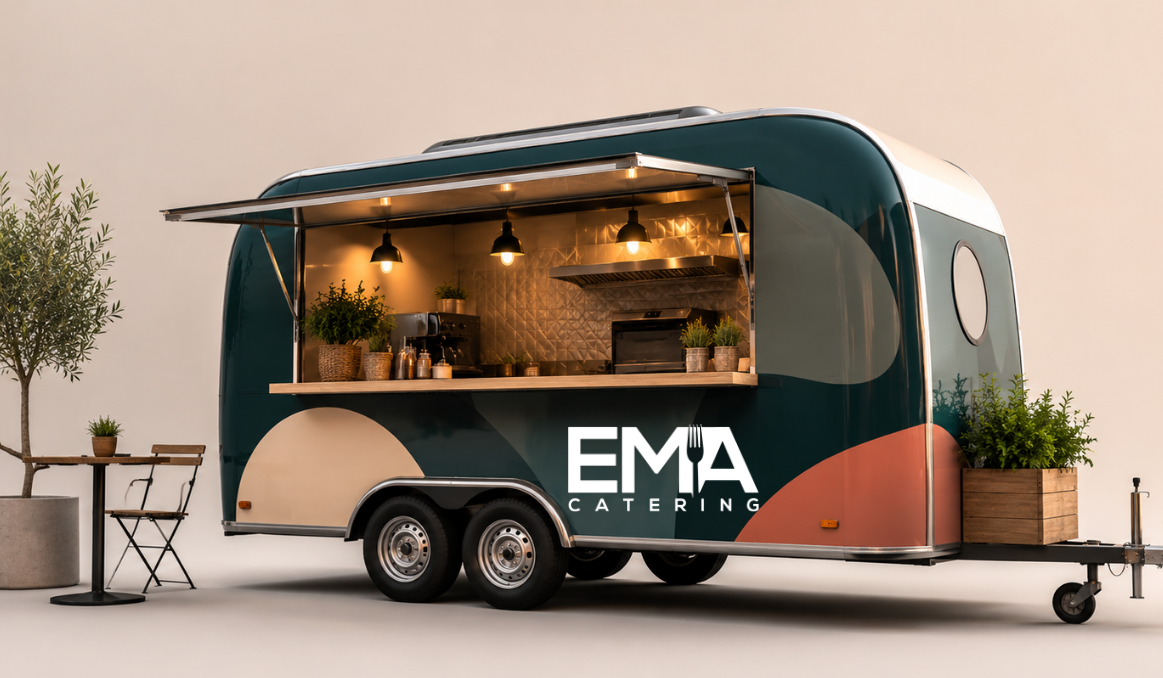
A blank white trailer says nothing. A well-branded one does half your marketing before a single customer reaches the hatch. We have operated branded mobile catering units at events for three decades, and the difference a sharp wrap and a clear menu board make to footfall is not subtle, it is the difference between people walking past and people queuing. This guide covers where to actually buy these units in the UK, what “custom branding” really means once you get past the sales talk, and the things we have learned the expensive way about getting it right.
First, know which type of unit you need
“Mobile catering unit” is a broad term, and the right one depends on your food, your pitch and how mobile you really need to be. Branding works differently across each, so settle the format before you talk to suppliers.
| Unit type | Best for | Branding opportunity |
|---|---|---|
| Catering van | Street trading, events, daily mobility | Full vehicle wrap, roof and serving-side graphics |
| Catering trailer | Festivals, markets, static-but-towable pitches | Large flat panels, ideal canvas for big branding |
| Kiosk or pod | Fixed venues, shopping centres, stadiums | Structural branding, signage, lighting |
| Cart or tricycle | Indoor events, tight spaces, premium feel | Compact, characterful, vintage or modern styling |
| Converted horsebox | Weddings, boutique events, on-trend look | Bespoke finishes and statement styling |
Where to buy mobile catering units in the UK
The market for mobile catering units splits into established manufacturers, conversion specialists, and the used and marketplace end. Where you buy shapes how good your branding can be, because the best results come when the unit is designed and wrapped as one job rather than bought blank and decorated as an afterthought.
Established manufacturers
Specialist UK builders design units from the chassis up and usually offer in-house or partnered branding, so the wrap, layout and serving design work together. Whitby Morrison, the Crewe-based, family-run firm widely regarded as the world’s leading ice cream van manufacturer, is the obvious example for ice cream and dessert units, and explicitly offers fully customised, branded vehicles built to reflect your business. Buying from a manufacturer costs more, but you get a coherent, durable, professional result rather than a patchwork.
Conversion and trailer specialists
A large part of the market is conversion specialists who turn panel vans, trailers, horseboxes and pods into catering units and finish them with custom wraps and signage. Quality varies hugely here, so the work and the references matter more than the brochure. A good converter will show you previous branded builds and talk you through the wrap material, the layout and the serving flow, not just the price.
Used units and marketplaces
At the budget end, used units appear on sites like Secondhand Catering Equipment, general listings on eBay, and trade marketplaces. You can re-wrap a sound used unit to your own brand for a fraction of a new build, which is a smart route if the underlying body, electrics and equipment are solid. Just budget for a professional re-wrap, because a cheap or peeling wrap undoes the saving instantly.
What “custom branding” actually involves
Branding is more than slapping a logo on the side. Done properly it is a system that makes your unit recognisable, appetising and easy to buy from, even at a distance in a crowded field. These are the elements that matter.
| Branding element | What it does | Worth paying for? |
|---|---|---|
| Full vinyl wrap | Turns the whole unit into a brand statement | Yes, the single biggest visual impact |
| Menu and price boards | Speeds decisions and keeps the queue moving | Yes, clear boards lift sales directly |
| Illuminated signage | Visibility at dusk, evening and indoor events | Yes for evening and year-round trading |
| Serving-hatch styling | Frames the point of sale, looks professional | Yes, it is where the customer actually looks |
| Staff uniforms and props | Extends the brand to the whole experience | Often, for premium and corporate events |
What it tends to cost
Prices vary with the unit, the spec and the complexity of the design, so treat these as an indicative 2026 guide and confirm current pricing with suppliers. The headline point is that branding is a small fraction of the unit cost but a large fraction of its commercial impact, which makes it one of the better-value parts of the whole investment.
| Item | Indicative price guide | Notes |
|---|---|---|
| New bespoke unit | From tens of thousands upward | Highest quality, often branding included or partnered |
| Converted van or trailer | Mid four figures to low five figures | Depends heavily on converter and spec |
| Used unit, then re-wrap | Lower entry, plus wrap cost | Smart if body and equipment are sound |
| Full professional vinyl wrap | Roughly a few thousand pounds | Varies by unit size and design complexity |
| Menu boards and signage | Hundreds to low thousands | High return for the spend |
What to check before you buy a branded unit
The branding is the fun part, but the unit underneath has to be sound and legal. Whatever supplier you use, run through these first.
Food safety registration. Operating any mobile catering units makes you a food business, so you must register with your local authority at least 28 days before trading, which is free. You can confirm the rules on the Food Standards Agency website, and you will be inspected and given a hygiene rating.
Build quality and equipment. Check the body, the electrics, the gas if fitted, the refrigeration and the serving layout. A beautiful wrap on a failing unit is money wasted. Ask for service history on used units and certificates on anything gas or electrical.
Wrap material and warranty. A professional wrap should use durable cast vinyl built to survive weather, washing and years of trading, and should come with some guarantee. Ask what material is used and how long it is expected to last, because a cheap wrap fades, peels and cheapens the whole unit.
Branding ownership and files. Make sure you own the final design artwork and have the print-ready files. If you ever need to repair a panel or build a second unit, you want to reproduce the brand exactly, not start again.
Case study: how branding changed our footfall at events
Here is our own experience, because it is the clearest proof we can offer. For years we ran functional units that did the job but blended into the background at busy festivals. Good food, plain looks, average queues.
When we invested in proper branding, consistent wraps, clear illuminated menu boards and a styled serving hatch across our units, the change at events was immediate and measurable. People spotted us from across the site, the brand looked established and trustworthy before anyone tasted a thing, and queues formed faster because the menu was readable at a glance. At evening events the illuminated signage kept us visible and selling long after plain units had effectively disappeared into the dark. Organisers also started requesting us by name, because a smart, consistent unit reflects well on their event too.
The spend on branding was modest next to the cost of the units themselves, but it did more for our takings than almost any other single investment. The lesson we pass on: do not treat branding as decoration you add at the end. Design the unit and the brand together, and treat it as a sales tool, because that is exactly what it is.
Why EMA Catering understands branded units
EMA Catering has run branded mobile catering units at events since 1995, so we know from experience how much a sharp wrap and a clear, illuminated menu board change footfall. Our units are designed to sell as well as serve, which is exactly the lesson this guide is built around: treat branding as an investment, not decoration.
We are a family-run business with a strong food hygiene rating, full public liability insurance, and a clear allergen process. We source HMC-certified halal meat and run a solar-powered Whitby Morrison ePower fleet, and our consistent branding is part of why organisers request us by name. If you would rather hire fully branded, professionally run units for an event than buy your own, EMA Catering can provide them directly.
Questions to ask any supplier
Take this list to every manufacturer, converter or dealer you approach. The answers reveal who will deliver a unit that actually sells.
- Can you design and brand the unit as one job, or is wrapping handled separately?
- Can I see previous branded builds and speak to those clients?
- What wrap material do you use, and what guarantee comes with it?
- Will I own the final artwork and receive print-ready files?
- Is the unit food-safe and ready to register, with the right certificates?
- What is the build quality of the body, electrics, gas and refrigeration?
- Do you offer menu boards, illuminated signage and serving-hatch styling?
- What is the lead time from order to a finished, branded unit?
If you would rather hire fully branded mobile catering units for an event instead of buying, that is something we do directly. You can explore our event catering services, see events we have worked, or tell us your date and requirements and we will respond within one working day.
The bottom line
You can buy mobile catering units from established manufacturers, conversion specialists, or the used market, and all three can carry strong custom branding, but the best results come when the unit and the brand are designed together. Check the build quality, the food-safety basics and the wrap material before you fall for the design, and insist on owning your artwork. Get it right and a branded unit does not just serve food, it markets your business at every event, in every photo, to every passer-by. That is why we treat branding as an investment, not an extra.
Frequently asked questions
Q: What are mobile catering units?
A: Mobile catering units are movable food-service setups such as catering vans, trailers or other mobile units used to prepare and serve food at events. The appropriate unit depends on the food concept, site and expected demand.
Q: Can I hire mobile catering units for an event?
A: Yes. EMA Catering provides mobile catering units as part of its event catering operation. The available units, menus, staffing and setup should be confirmed for the specific event.
Q: Can mobile catering units be branded for an event?
A: Branded units can be used to support event visibility and sponsor or organiser branding where the service allows it. EMA should confirm the available branding options for the requested event.
Q: Do mobile catering units come with staff?
A: Staffing depends on the catering package. EMA should clearly state on the page whether the quoted service includes catering staff, and what staffing level is recommended for different event sizes.
Q: Can mobile catering units cater for large festivals?
A: Yes. Mobile units can be used as multiple service points for festivals and high-footfall events. The number of units and staff should be planned around expected footfall and peak service periods.
Q: What information do you need to quote for mobile catering units?
A: Provide the event date, location, event type, expected guest numbers, service times, menu requirements and any branding or dietary requirements. This allows EMA to recommend an appropriate setup.
EMA Catering is a London family-run caterer working events since 1995, running branded mobile catering units alongside its festival, corporate and event catering. Get a quote.