
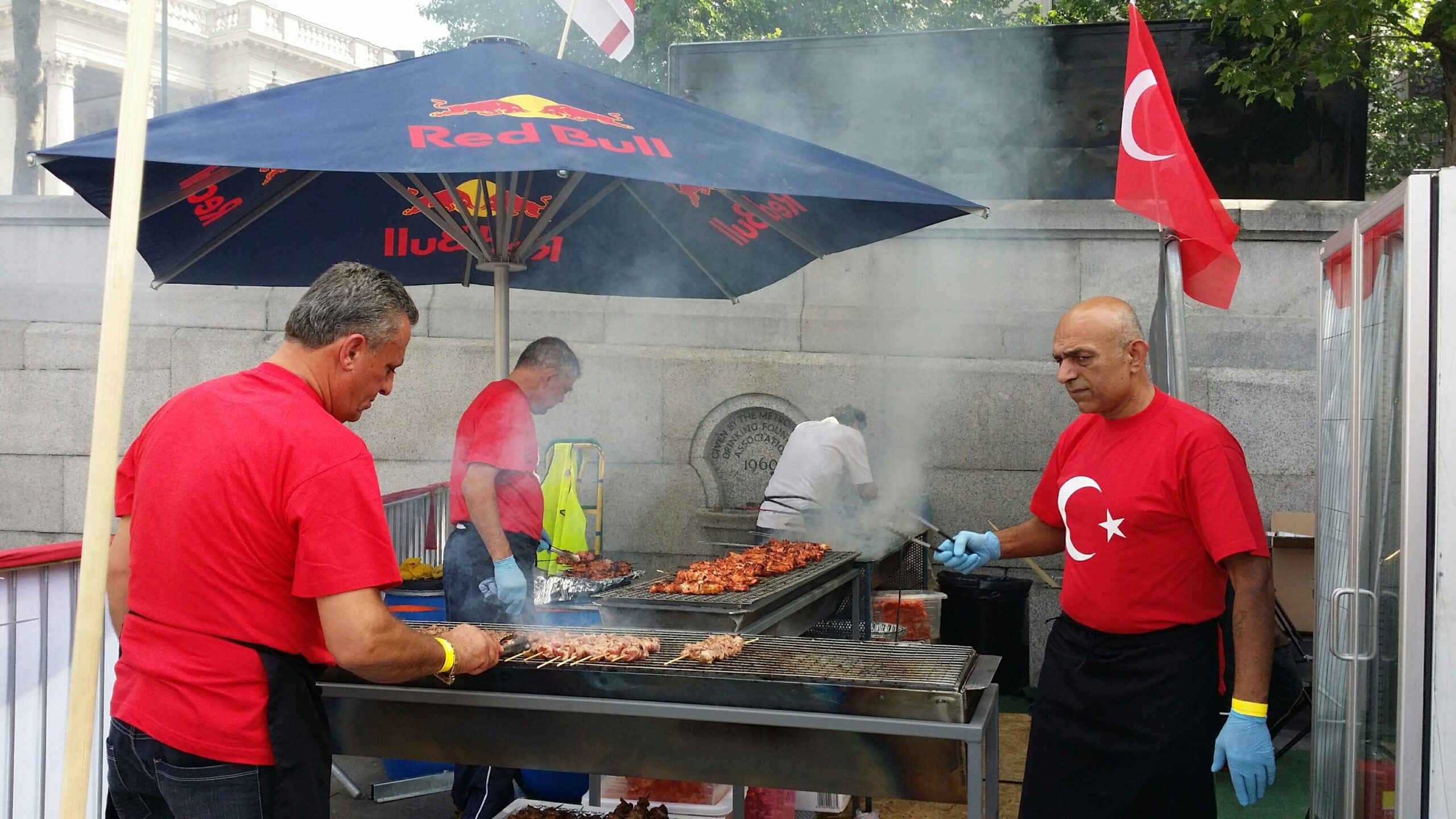
If you have ever stood in a muddy field at 6am watching a generator refuse to start while a thousand hungry people are about to walk through the gate, you already know the truth about festival catering. The food matters, but reliability matters more. A brilliant menu means nothing if the unit does not turn up, the hygiene paperwork is missing, or the queue stops moving on day two.
We have catered at Glastonbury, Womad, Notting Hill Carnival and Hyde Park Winter Wonderland, and we have served more than 5,000 visitors at a single event. So this guide is not theory. It is the same checklist we wish every event organiser used before they signed a contract, and the same standard we hold ourselves to as a festival catering company in the UK. If you are booking a caterer for a festival, fete, council programme or corporate day out, here is how to separate the people who can actually deliver from the ones who only look good on a quote.
Why “reliable” means something specific in festival catering
Reliability in this world is not a vibe. It is a set of things you can check. A festival caterer is running a temporary kitchen, often off-grid, in changeable weather, feeding huge volumes against a clock. The margin for error is tiny. When organisers come to us after a bad experience, the story is almost always the same: the caterer was charming, the food samples were lovely, and nobody checked the boring things.
The boring things are what keep your event safe, legal and on schedule. Let us go through them in the order they actually matter.
1. Check they are legally registered and inspected
Every food business in the UK, including mobile and temporary outlets, must register with their local authority. This is a legal requirement, and it has to happen at least 28 days before they start trading. Registration is free and it lets the council keep food premises on the public safety radar. You can verify the rules on the Food Standards Agency website.
Once registered, a food safety officer inspects the business and awards a Food Hygiene Rating on a scale of 0 to 5. As of 2026 the scheme covers more than 430,000 UK food businesses, and around 78 percent of them hold the top rating of 5. That tells you the bar is achievable, so anyone trading well below it is a question mark, not a bargain. You can look up any caterer’s rating yourself on the FSA rating search before you ever pick up the phone.
A quick word of caution that we have seen catch people out: in England the display of the rating sticker is still voluntary, so the absence of a sticker on a unit does not always mean a bad score. Check the online register rather than relying on what is taped to the serving hatch.
2. Confirm insurance, and read what it actually covers
A real festival caterer carries public liability insurance, and most reputable festivals will not let a vendor on site without it. Ask for the certificate, check the cover level, and check the dates line up with your event. Many large events now ask for five million pounds of public liability cover as a minimum, and some ask for ten. If a caterer hesitates or sends you something that expired last season, that is your answer.
Employers’ liability is the other one to ask about if the caterer is bringing a team, which on a festival they almost always are. It is a legal requirement for most businesses with staff, and on a busy field you want everyone working that line to be covered.
3. Allergen handling is not optional any more
Since October 2021, the law known as Natasha’s Law has changed how caterers must label food across the UK. Any business producing food that is prepacked for direct sale — think packaged sandwiches, cakes, salads or pots of soup made and packed on site — must label it with the name of the food and a full ingredients list, with the 14 major allergens emphasised. This applies directly to event caterers, as the FSA spells out in its guidance for the sector.
The law was named after Natasha Ednan-Laperouse, who died at 15 after eating a baguette with hidden sesame. That history is why we take this seriously and why you should too. In March 2025 the FSA went further, encouraging caterers to provide written allergen information even for loose, non-packaged food. When you interview a caterer, ask them to walk you through their allergen matrix. If they look blank, walk away.
The reliability checklist, at a glance
Here is the short version we hand to organisers. If a vendor cannot tick every row, you have found your weak link before the event, not during it.
| What to check | Why it matters | How to verify it | Red flag |
|---|---|---|---|
| Food Hygiene Rating | Proof of inspected, lawful kitchen standards | Search the FSA online register by business name | Rating of 2 or below, or no record at all |
| Public liability insurance | Covers injury or damage to the public | Ask for the certificate and check cover and dates | Expired, vague, or “we’ll sort it nearer the time” |
| Allergen compliance | Legal duty under Natasha’s Law, protects guests | Ask to see their allergen matrix and PPDS labels | No matrix, no labelling system, no clear answer |
| Capacity for your footfall | Keeps queues moving across the full event | Ask how many covers per hour, per unit | Numbers that do not match your expected crowd |
| Off-grid power and water plan | Festivals are rarely plug-and-play | Ask about generators, solar, water bowsers, waste | They assume mains power will be there |
| Track record at similar events | Field experience cannot be faked | Ask for named events and references | Only weddings or photos, no event references |
4. Match the caterer to your crowd, not just your menu
This is the mistake we see most. Organisers fall in love with a menu and forget to ask whether the operation can physically feed the number of people walking through the gate. A unit that is wonderful at a 200-person wedding can drown at a 5,000-person festival.
When we plan a deployment, throughput is the first conversation, not the last. A single well-run unit might comfortably serve a few hundred covers across a session, but a multi-stage festival needs multiple branded units positioned so the crowd never has to walk too far or wait too long. Ask any prospective caterer a blunt question: how many people can you serve per hour, per unit, and how many units will you bring for my expected footfall? A confident, specific answer is a good sign. A shrug is not.
A rough guide to matching capacity to event size
| Event size (peak footfall) | Typical setup | What to prioritise |
|---|---|---|
| Up to 500 | 1 to 2 units, focused menu | Speed of service and a tight, popular menu |
| 500 to 2,000 | 2 to 4 units, spread across the site | Queue management and varied dietary options |
| 2,000 to 5,000+ | Multiple units per zone, dedicated field team | Throughput, logistics, off-grid power and waste |
| Multi-day festival | Branded units, on-site team, restock plan | Pack-in to pack-out planning and resilience |
These are starting points, not gospel. Weather, site layout and the type of audience all shift the maths. But if a caterer cannot have this conversation with you in concrete terms, they have probably not worked at your scale.
5. Look for sustainability and dietary range as standard
Festival audiences in 2026 expect more than they did a decade ago. Halal, vegetarian, vegan and allergen-aware options are no longer a nice extra, they are the baseline for a diverse crowd. We made a decision years ago to source from HMC-certified halal suppliers and to run a solar-powered Whitby Morrison ePower ice cream fleet, because that is where audiences and venues are heading. A modern festival catering company in the UK should be able to tell you, without hesitation, how it handles dietary range and how it manages its environmental footprint. The good ones will already have answers, because clients and councils are asking.
Case study: feeding a multi-day festival without a single gap in service
Here is one from our own field, lightly anonymised at the organiser’s request, that shows what reliability looks like when it goes right.
An established multi-day music festival in the South of England came to us after a previous caterer had let them down badly the year before. The complaint was not the food, it was the chaos: one over-stretched unit, queues that snaked past other stalls, and a kitchen that ran out of stock by the middle of the second afternoon. Footfall was around 5,000 a day across the site.
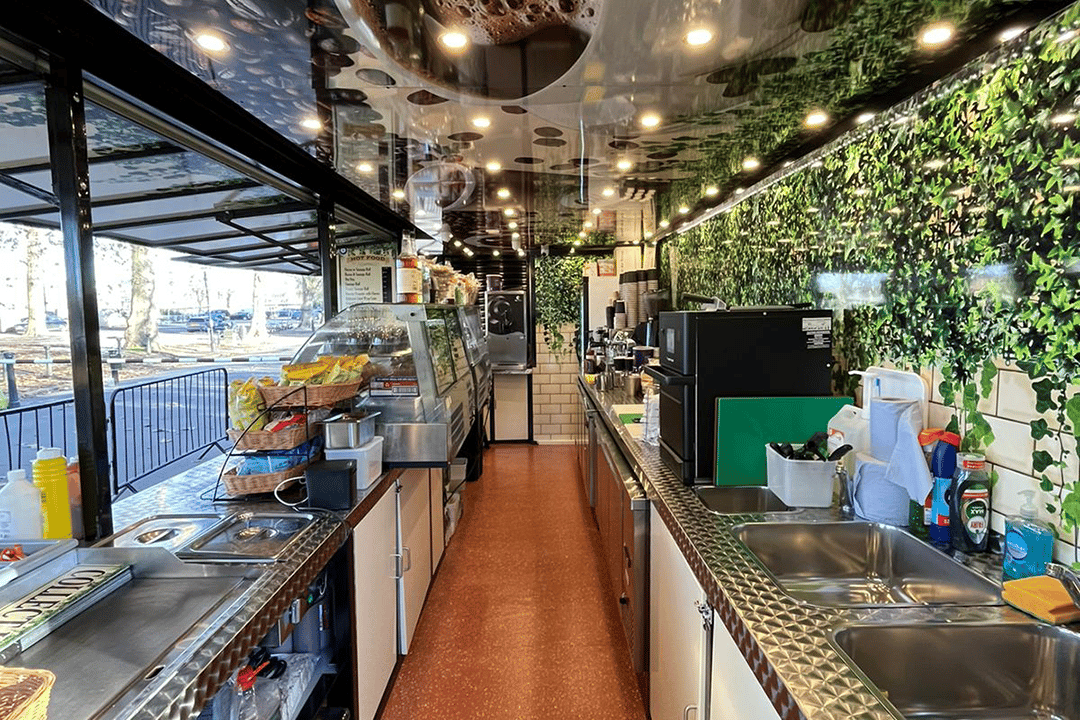
We started where we always start, with throughput and layout rather than menu. We deployed multiple branded units, positioned near the main stage areas so the crowd flow spread the demand instead of concentrating it. The menu was built around HMC-certified halal lines and a small number of fast, popular dishes that could be served quickly without dropping quality, because a complicated menu is the enemy of a moving queue. An EMA-trained field team ran the operation from set-up through to strike, with a restock plan built in so no unit could run dry mid-session.
The result was straightforward. Service held steady across all three days, queues kept moving even at peak, and the organiser later told us the food generated more positive comments than any vendor they had used.
A queue is the best review — but only if it keeps moving.
Festival organiser · client reference
That deployment became part of the operational playbook we now reuse for festivals of similar scale. The lesson is not that we are special. The lesson is that the difference between a smooth event and a stressful one was almost entirely in the unglamorous planning: capacity, positioning, restock and a trained team. Those are exactly the things you can ask a caterer about before you book.
Questions to ask before you sign anything
Take this to every catering conversation. The answers tell you more than any glossy brochure.
- What is your current Food Hygiene Rating, and which authority registered you?
- Can I see your public liability insurance certificate and cover level?
- How do you handle allergens, and can I see your allergen matrix?
- How many covers can you serve per hour, per unit?
- How many units will you bring for my expected footfall?
- What is your plan for power, water and waste on an off-grid site?
- Which comparable events have you worked, and can you provide references?
- What dietary options do you offer as standard?
- What does your set-up and pack-down look like, and who runs it?
The bottom line
Finding a reliable festival caterer in the UK comes down to verifying a handful of unglamorous things before you are charmed by the menu. Check the hygiene rating on the FSA register. Read the insurance certificate properly. Make them prove their allergen process. Match their capacity to your crowd, not the other way round. And ask for real event references, because three decades on the field has taught us that field experience is the one thing nobody can fake.
Get those right and the food will be the easy part. Get them wrong and no menu in the world will save day two. Choose a festival catering company in the UK that can evidence every one of these things, and you give your event the best possible chance of running smoothly from gate to strike.